Koraput
Koraput Regional Office covers the district of Koraput and also oversees work in Malkangiri, Rayagada, Kalahandi and Nuapara Districts through field offices and staff in those areas. These tribal-dominated districts are located in the Eastern Ghats mountain range and are amongst the poorest in India.
There are a number of development issues which impact upon the people living here, including :
These have lead to very high poverty levels,where a large proportion of families live below the poverty line. Our focus on community-based natural resource management aims to ensure that poverty-stricken tribal peoples can gain greater control over the resource base, improving their economic circumstances while at the same time managing their resources in a sustainable way.
Koraput Regional Office covers the district of Koraput and also oversees work in Malkangiri, Rayagada, Kalahandi and Nuapara Districts through field offices and staff in those areas. These tribal-dominated districts are located in the Eastern Ghats mountain range and are amongst the poorest in India.
There are a number of development issues which impact upon the people living here, including :
- lack of security of tenure over agricultural, forest and common land.
- low levels of literacy and formal education.
- poor market and transport linkages.
- deforestation and environmental degradation.
- prevalence of diseases such as malaria and dengue.
- migration in search of work.
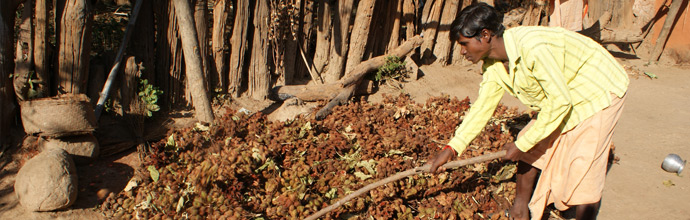
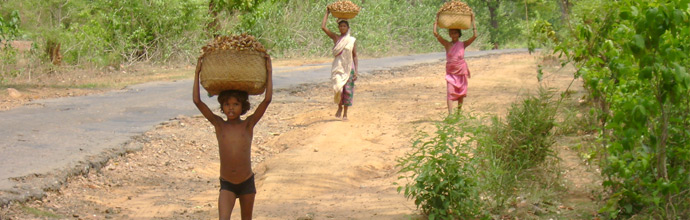
The main focus of work in Koraput over the past 10 years or so has been the market access programme for Non-Timber Forest Products, otherwise known as NTFPs. NTFPs include fruits, leaves, bark, honey, flower and seeds and they have long been an important source of income and subsistence for tribals who dwell in and near the forests. However, the primary collectors have historically received minimal benefits from the trade in NTFPs and the market was long controlled by traders and the state government with little consideration for tribal welfare.
A policy change at state level in 2000 passed control of NTFPs to the Gram Panchayats and opened up new opportunities in this sector. RCDC was quick to realise the potential for improving the situation of primary collectors and producers.
Support for the market access programme was provided by the Ford Foundation and the EU. Beyond the end of these funding programmes, the aim is to carry on the work of the cooperatives and further grow and develop them as self-sustaining business entities. The market access programme was set in motion with two principal aims :
1. To enhance the income of the primary collectors and producers of NTFPs through product development and processing, value addition and sales & marketing.
2. To protect the natural resource base through sustainable community forest management.
Female Empowerment
Research
A policy change at state level in 2000 passed control of NTFPs to the Gram Panchayats and opened up new opportunities in this sector. RCDC was quick to realise the potential for improving the situation of primary collectors and producers.
Support for the market access programme was provided by the Ford Foundation and the EU. Beyond the end of these funding programmes, the aim is to carry on the work of the cooperatives and further grow and develop them as self-sustaining business entities. The market access programme was set in motion with two principal aims :
1. To enhance the income of the primary collectors and producers of NTFPs through product development and processing, value addition and sales & marketing.
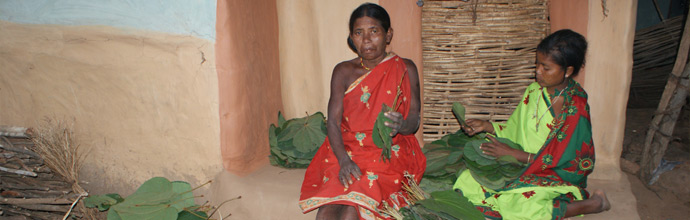
This has been achieved by facilitating the establishment Self-Help Cooperatives (SHCs) at village level that are owned and controlled by the primary collectors, most of whom are women. Training has been provided on product processing and the SHCs now process the NTFPs into a wide range of food, medicinal and cosmetic products. Three outlet stores have been opened in Koraput, Chatikona and Bhawanipatna. Market linkages have been developed through two apex level cooperatives and one state level producer’s institution, VARASA. The Banaja brand has been developed to market and promote VARASA’s wide range of produce.
2. To protect the natural resource base through sustainable community forest management.
Sustainable harvesting protocols were developed and training has been provided to primary collectors so that NTFPs are not harvested in a destructive manner and are conserved for the future. The project also aims to ensure community rights to and control over forests as per PESA and the FRA. Individual and community claims under the FRA have been submitted. Empowerment of the Gram Panchayats, Forest Protection Committees, SHCs and other local institutions to build their capacity on sustainable management has also been a key focus of the programme.
Female Empowerment
As well as promoting free trade and sustainable resource management, the market access programme has had a strong focus on female empowerment from the outset and women producers are heavily involved in the cooperatives. The programme has also prohibited child labour.
To find out more about the market access programme and some key achievements of recent years, please read more of our case studies.
To find out more about the market access programme and some key achievements of recent years, please read more of our case studies.
Research
In November 2011, staff of the Koraput field office carried out a pilot study in Khariguda village to examine the possible impact of climate change on NTFPs. A focus group discussion was held with villagers and their perceptions of climate change and its impact on forest produce was sought.
Some interesting points emerged, but the findings cannot be considered conclusive given that just one village was studied. It is now proposed to undertake a wider qualitative study of 10-12 villages across the districts of Koraput, Rayagada, Kalahandi and Malkangiri to gather more detailed data that will provide greater clarity on the nature of the climate change/NTFP relationship. Field studies will commence in March 2012 and the study should be complete in June 2012. The need for this study arises from two realities, namely the high dependence on NTFPs in this part of Odisha and the undoubted fact that climate change will have an increasing impact on the natural environment and forests.
Some interesting points emerged, but the findings cannot be considered conclusive given that just one village was studied. It is now proposed to undertake a wider qualitative study of 10-12 villages across the districts of Koraput, Rayagada, Kalahandi and Malkangiri to gather more detailed data that will provide greater clarity on the nature of the climate change/NTFP relationship. Field studies will commence in March 2012 and the study should be complete in June 2012. The need for this study arises from two realities, namely the high dependence on NTFPs in this part of Odisha and the undoubted fact that climate change will have an increasing impact on the natural environment and forests.
Our Operational Area