Balangir
Balangir (sometimes written Bolangir) was one of the districts from which RCDC first initiated its field programmes and grassroots actions, in 1993. After conducting field research of forest protection activities, we recognised the need for an intervention to resolve forest-related conflict and so started work on alliance building from village up to regional levels. The established alliances were federated and the District Forest Federation was born.
Over time, other issues relating to natural resources emerged as concerns in the district and the Balangir office began to diversify its work. Forest protection groups were encouraged to broaden their focus and, slowly, sustainable agriculture, organic farming, soil and water became integrated into RCDC’s work in Balangir. As our presence grew, the District administration invited us to participate in their development activities.
Towards the turn of the century, an agrarian crisis was emerging with Balangir at the forefront. Farming communities faced drought, crop failure, indebtedness and exploitation. Many were forced to migrate to find work. We acknowledged the growing problem and have since been involved in supporting communities to abate indebtedness and check migration through measures such as providing alternative livelihood options, encouraging organic agriculture as an alternative to cash cropping,linking people up with government schemes they are eligible for and strengthening local governance systems.
Our community-driven, rights-based initiatives have now penetrated into to 650 villages, with active direct grassroots interventions in 228 villages. Programmes implemented in Balangir are
 1. Food security and sustainable agriculture
 2. Governance
3. Forest conservation and protection
2. Governance
3. Forest conservation and protection
Balangir (sometimes written Bolangir) was one of the districts from which RCDC first initiated its field programmes and grassroots actions, in 1993. After conducting field research of forest protection activities, we recognised the need for an intervention to resolve forest-related conflict and so started work on alliance building from village up to regional levels. The established alliances were federated and the District Forest Federation was born.
Over time, other issues relating to natural resources emerged as concerns in the district and the Balangir office began to diversify its work. Forest protection groups were encouraged to broaden their focus and, slowly, sustainable agriculture, organic farming, soil and water became integrated into RCDC’s work in Balangir. As our presence grew, the District administration invited us to participate in their development activities.
Towards the turn of the century, an agrarian crisis was emerging with Balangir at the forefront. Farming communities faced drought, crop failure, indebtedness and exploitation. Many were forced to migrate to find work. We acknowledged the growing problem and have since been involved in supporting communities to abate indebtedness and check migration through measures such as providing alternative livelihood options, encouraging organic agriculture as an alternative to cash cropping,linking people up with government schemes they are eligible for and strengthening local governance systems.
Our community-driven, rights-based initiatives have now penetrated into to 650 villages, with active direct grassroots interventions in 228 villages. Programmes implemented in Balangir are
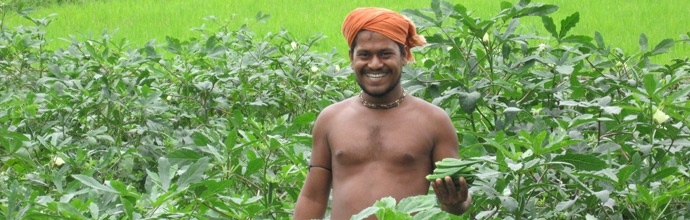
1. Food security and sustainable agricultureBalangir has been continuously in the news for starvation death, malnutrition, migration and, more recently, swathes of farmer suicides. There is a clear need for interventions to support and guide communities as they battle agricultural distress and food insecurity. Since 2004, we have been working with 50 villages in 10 Gram Panchayats to address the issue.
Core Activities :
Core Activities :
- Capacity building of farmers.
- Promoting the cultivation and use of vermi-compost (a self-sustaining and environmentally friendly fertiliser).
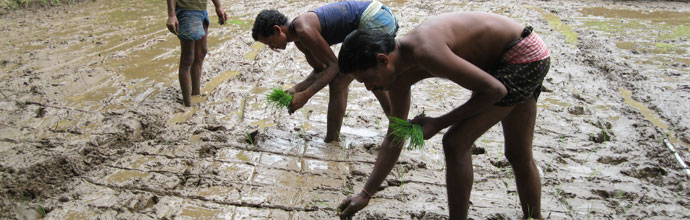
- Taking a farmer-led approach to promote SRI (System of Rice Intensification) cultivation patterns.
- Compost and liquid manure preparation.
- Linking individuals and groups to government schemes they are eligible for.
- Demonstrating new, more sustainable agricultural practices to farmers and supporting them as they adopt them.
- Education of the wider community on food insecurity issues.
- Ensure not a single starvation death at least in our project areas.
- Advocacy and campaigning on food security and agricultural issues to influence key decision making.
Recent Achievements :
- As a result of the intervention, the number of farmers adopting the SRI method has increased from 180 in the year 2000 to over 2000 last year.
- 130 farmers now create vermi-compost and 120 farmers have availed support through linkage with the Agriculture Department.
- In order to ensure seed quality, sustainability, and independence from the open market, we have set up 40 seed banks, which are now maintained in 40 operational villages in 13 Gram Panchayats.
- As a part of an advocacy strategy, discussions were made with district administration, District Collector and District Welfare Officer.
2. Governance3. Forest conservation and protectionOur Operational Area